Marketing Attribution
Zero-Click Attribution Crisis 2025: What Socrates Would Ask About Invisible Influence
Zero-Click Attribution Crisis 2025: What Socrates Would Ask About Invisible Influence
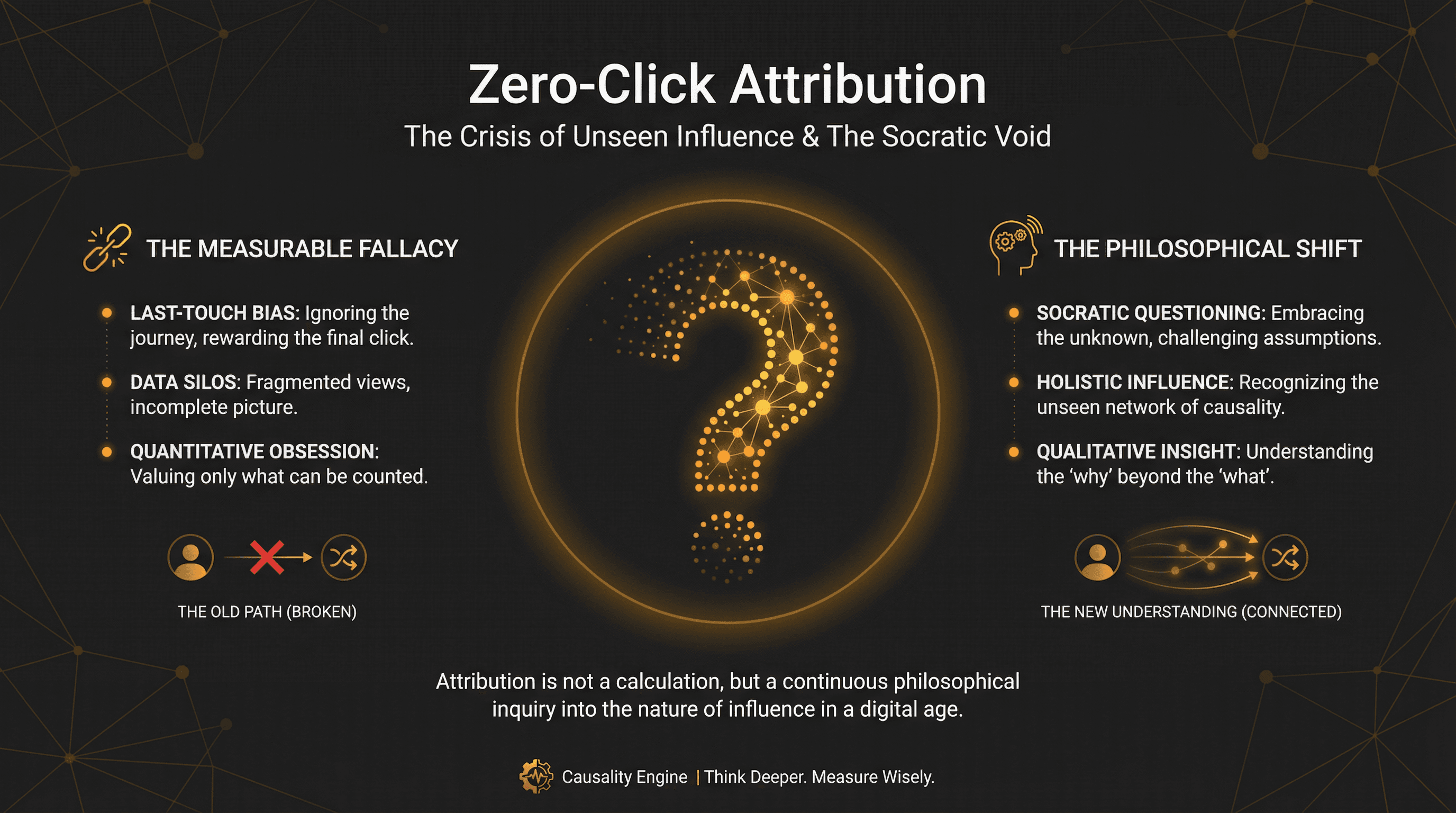
For over a decade, marketers operated under a simple, comforting creed: if you can click it, you can track it. We built empires of analytics on this foundation, optimizing every step of the customer journey with a satisfying sense of precision. But as Matt Bahr of Fairing recently pointed out, this model is quietly breaking [1]. The rise of generative AI tools like ChatGPT, Perplexity, and Google's AI Overviews has created a "zero-click" reality. Consumers find what they need within an AI interface and navigate directly to a brand, leaving no digital breadcrumbs. Our dashboards show nothing, yet a decision was made. Influence occurred, invisibly.
This isn't a technical problem; it's a philosophical one. We are flying blind, armed with outdated maps. If Socrates were a modern CMO, he wouldn't be asking for a better dashboard. He would be questioning the very nature of our knowledge. He would force us to confront the uncomfortable truth that we may not know what we think we know.
The Unexamined Dashboard is Not Worth Trusting
Socrates famously claimed, "The unexamined life is not worth living." In 2025, the unexamined marketing dashboard is not worth trusting. We have become so reliant on the data we can easily collect that we have forgotten to question what we cannot see. Let us apply the Socratic method to our current marketing attribution crisis.
Imagine Socrates in your weekly marketing meeting, calmly posing a series of questions that unravel your entire strategy:
You say your paid search campaigns are driving a 4x ROAS. But how do you know the customer's intent was not formed elsewhere, in a place you cannot measure? Are you measuring the final click or the first spark of curiosity? If a customer asks an AI, "What's the best mattress for back pain?" and is told about your brand, then later searches for your brand name directly, did Google create that customer, or merely deliver them?
You have optimized your Customer Acquisition Cost (CAC) down to €50. But what is the cost of the influence you cannot quantify? If a podcast mention, a community recommendation, or an AI-generated summary is what truly convinces a customer, is your CAC calculation an accurate reflection of reality, or an illusion of precision?
You believe your marketing mix is diversified. But if all your channels rely on the same flawed last-click attribution model, are you truly diversified, or are you simply measuring the same distorted reality in different ways? Are you investing in what works, or what is easily measured? And do you know the difference?
You claim to be data-driven. But if your data only reflects a fraction of the customer journey, are you driven by data, or by the comfort of familiar metrics? What is the value of a map that only shows half the territory? Does it lead to insight, or simply to the edge of a cliff you cannot see?
You plan to increase your marketing budget by 20% next quarter. On what basis do you make this decision? Is it based on a true understanding of how demand is created, or on a set of metrics that are increasingly detached from reality? How can you build a future on a foundation you can no longer trust?
These questions are not meant to be cynical. They are a call to intellectual honesty. They force us to admit the limits of our knowledge and to seek a deeper, more fundamental understanding of how our customers truly discover us.
The Examined Life of a Marketer in 2025
To live an examined marketing life in the era of zero-click search is to embrace uncertainty and prioritize truth over comfort. It means accepting that the most important marketing moments often happen long before anyone clicks a button. The path forward is not to find a new way to track every interaction, but to build a more resilient and holistic understanding of influence.
This requires a shift in mindset, from a channel-centric view of "Where did this convert?" to a discovery-centric one of "Where did this begin?" It means valuing signals that show up before the conversion, not just at the checkout. It means augmenting our quantitative data with qualitative insight. It means, in short, talking to our customers.
Fairing's analysis of millions of post-purchase survey responses is a perfect example of this new reality. By simply asking customers, "How did you hear about us?" they are uncovering the growing influence of AI in product discovery—a trend that is completely invisible to traditional analytics. This is the beginning of a new, more honest approach to marketing measurement.
The First Step: An Unbiased Audit
If these questions make you uncomfortable, good. That is the beginning of wisdom. The first step toward navigating this new landscape is to conduct a thorough and unbiased audit of your current attribution model. You need to understand where the gaps are, how exposed you are to the zero-click reality, and what your true cost of acquisition might be.
We offer a €1K audit designed to do exactly that. We will dissect your current measurement framework, identify the blind spots created by AI-driven discovery, and provide a clear, actionable roadmap for building a more honest and effective attribution system. It is not about finding new tricks; it is about seeking a more durable truth.
Frequently Asked Questions
What is the zero-click attribution crisis? The zero-click attribution crisis refers to the breakdown of traditional marketing attribution models due to the rise of AI-powered search. Consumers get answers and product recommendations directly from AI assistants, then navigate to a brand's site without clicking a measurable link, making their discovery journey invisible to standard analytics.
Why is last-click attribution no longer reliable? Last-click attribution was already a flawed model, but AI search has made it obsolete. It only credits the final touchpoint before a conversion, ignoring the entire upstream journey of discovery and consideration. In a zero-click world, the most influential touchpoints are often invisible, leading to a complete misrepresentation of what is actually driving growth.
How can I measure marketing influence in a zero-click world? The most reliable way to understand influence is to ask your customers directly. Post-purchase surveys, customer interviews, and other forms of first-party data collection are becoming essential. This qualitative insight, when combined with your existing quantitative data, provides a much more accurate picture of your marketing performance.
References
[1] Bahr, Matt. "How AI Search Is Upending E-commerce Discovery." Advertising Week, January 20, 2026. https://advertisingweek.com/how-ai-search-is-upending-e-commerce-discovery/
[2] "Marketing attribution." Wikidata. https://www.wikidata.org/wiki/Q136681891